


Despite the rise of high-density two-tier systems, the classic inverted-U Sheffield stand remains the gold standard of UK cycle parking. Endorsed by Department for Transport guidance LTN 1/20, Active Travel England, and BREEAM assessors, Sheffield stands and multi-space toast racks offer intuitive, step-free access for standard commuter bikes, step-through frames, e-bikes, and adapted cycles.
However, poorly spaced stands, thin-walled tubing, or non-compliant “wheel-bender” racks frequently fail planning conditions and public-realm audits. Below are the essential technical specifications required for long-term UK commercial and local authority installations.
Why Sheffield Stands Remain the UK Benchmark (LTN 1/20)
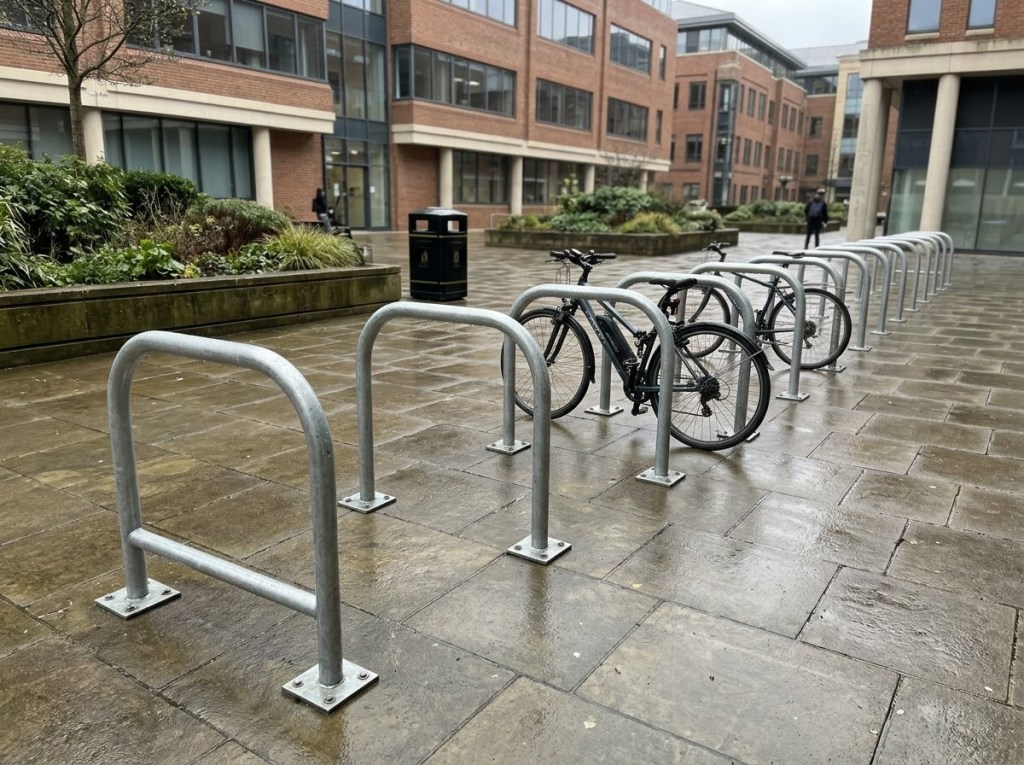
Under LTN 1/20 Chapter 11, compliant cycle parking must allow cyclists to secure both the bicycle frame and at least one wheel to an immovable stand using a standard D-lock, without bending wheel rims or scratching paintwork.
- Two-Point Frame Support: A minimum 750 mm horizontal top rail supports the bicycle at two points, preventing the frame from twisting or toppling over in wind.
- Universal Accessibility: Unlike raised trays or tight wheel slots, ground-level Sheffield stands require zero lifting—making them accessible for heavier e-bikes, cargo bikes, and riders of all ages and abilities.
- Why “Wheel-Bender” Racks Fail Audits: Low-profile racks that only grip the front tyre offer minimal theft resistance and can buckle rims, meaning they generally do not qualify for BREEAM credits or local authority planning sign-off.
Individual Sheffield Stands vs. Multi-Space Toast Racks
Both formats use inverted-U hoops, but the right choice depends on your groundworks budget, site layout, and future flexibility:
| Specification Feature | Individual Sheffield Stands | Multi-Space Toast Racks |
| Construction | Standalone tubular inverted-U hoops installed individually | Series of Sheffield hoops welded onto continuous ground-level steel runner rails |
| Groundworks & Fixing | Requires individual core holes or bolt-down pads for every stand | Minimises drilling—only the end and intermediate runner rails bolt to the slab |
| Best Site Applications | Public pavements, high streets, block paving, and bespoke curved layouts | Schools, retail parks, warehouse yards, and inside enclosed cycle compounds |
| Relocatability | Fixed permanently to the sub-base | Easier to unbolt, reposition, or install over sensitive surfaces (e.g., car park decks) |
Essential UK Spacing & Dimensional Benchmarks
To satisfy LTN 1/20 and prevent handlebar tangling during peak morning arrivals, verify these minimum dimensions on your site layout drawings:
- Stand Dimensions: Typically 750–800 mm wide by 750–800 mm above finished floor level (plus 250–300 mm root extension where cast in situ).
- Lateral Spacing Between Stands:
- 1,000 mm minimum centre-to-centre spacing for standard two-bike-per-stand capacity.
- 1,200 mm centre-to-centre spacing recommended on high-turnover commuter, school, and station sites so cyclists can load panniers easily.
- Clearance from Walls & Kerbs: Keep stands at least 500–600 mm clear of adjacent walls, cladding panels, or kerb edges so pedals and handlebars do not strike obstacles.
- Aisle Access Clearance: Maintain 2,000 mm+ of clear pedestrian and cyclist aisle space behind parked bicycles (or 3,000 mm between opposing rows of stands).
- Tapping Bars for Visually Impaired Pedestrians: Where Sheffield stands are installed on open pavements or shared public footways, specify a low-level horizontal tapping rail (set around 150–200 mm above ground level) so white-cane users can detect the stand safely.
Steel Specification, Finishes & Fixing Options
Every Kappion commercial Sheffield stand and toast rack is engineered for heavy daily public and workplace use:
- Structural Steel & Fabrication: Manufactured from heavy-gauge structural steel tube (typically 48.3 mm or 60.3 mm outer diameter) under EN 1090-2 certified Factory Production Control.
- DIN EN ISO 1461 Hot-Dip Galvanisation: Full-immersion zinc coating protects against internal and external rust, even where bike locks repeatedly scuff the steelwork.
- Architectural Polyester Powder Coating: Available over galvanising in any standard RAL colour (such as RAL 7016 Anthracite Grey or RAL 9005 Jet Black) to coordinate with your commercial cycle shelters and two-tier bike racks.
- Surface-Mounted vs. Root-Fixed Bases:
- Surface-Mounted Baseplates: Heavy-duty flanged plates with pre-drilled anchor holes for rapid installation onto existing concrete slabs.
- Root-Fixed (Submerged) Legs: Extended uprights cast directly into concrete foundation pads for maximum tamper resistance in public-realm locations.