


When designing cycle parking for commercial offices, rail stations, universities, or high-density residential developments, floor space is almost always at a premium. Two-tier bike racks double cycle storage capacity within the same structural footprint—making them one of the most effective commercial steel cycle parking systems for UK architects and developers looking to satisfy local planning conditions and BREEAM active travel credits.
However, specifying a two-tier system requires careful attention to headroom, aisle clearances, and lift assistance to ensure the facility complies with Department for Transport guidance LTN 1/20.
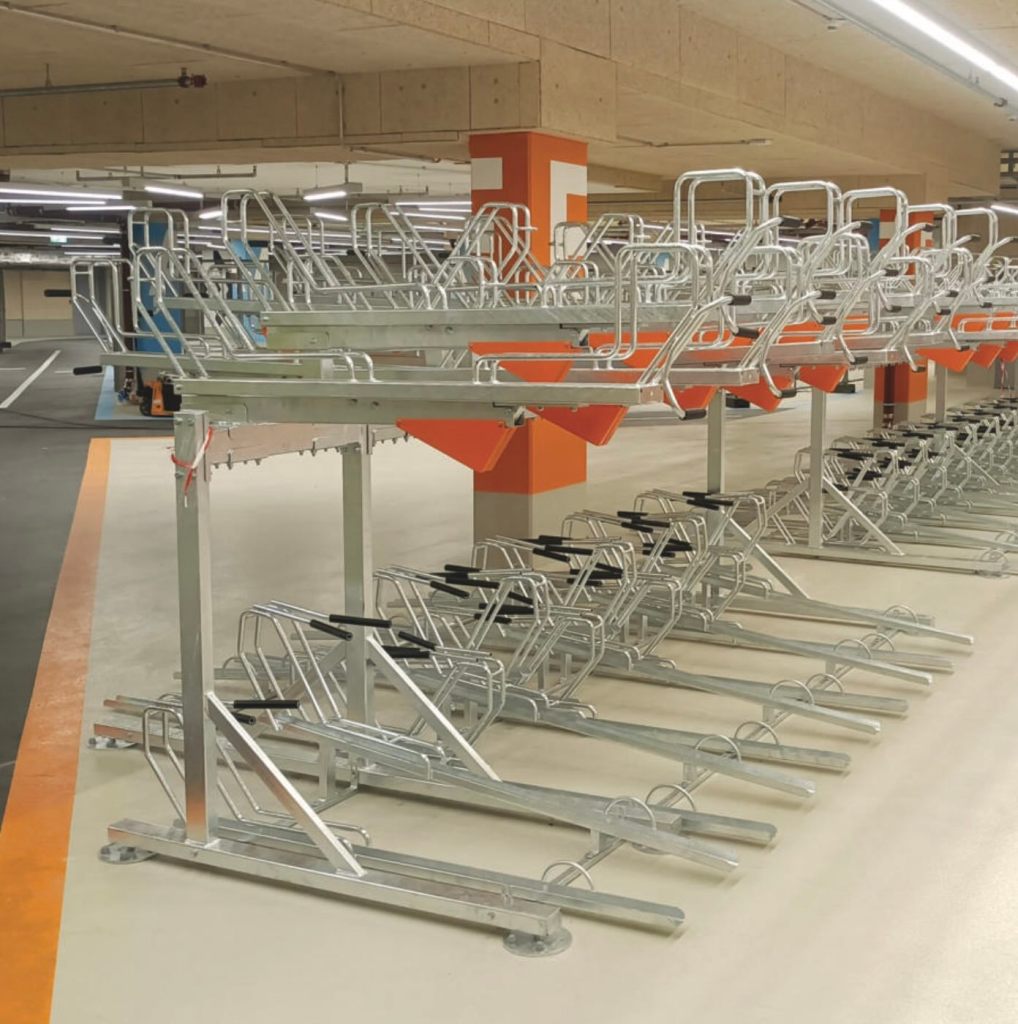
Why Specify Gas-Assisted Two-Tier Cycle Racks?
- Double Storage Density: By stacking bicycles on two levels, two-tier racks accommodate up to twice as many cycles per linear metre compared to standard single-level Sheffield stands.
- Gas-Strut Assisted Upper Trays: Integrated gas struts counterbalance the weight of the bicycle on the upper tier, allowing users of all strengths to lower the upper channel smoothly to ground level, load their bike, and raise it back into position with minimal effort—supporting LTN 1/20 accessibility expectations.
- Frame & Wheel Security: Heavy-duty steel locking loops allow cyclists to secure both the bicycle frame and front wheel using a standard D-lock, meeting insurance and planning security requirements.
Key UK Layout & Dimension Benchmarks (LTN 1/20)
Before locking in a basement car park layout or external cycle compound footprint, verify these core dimensional requirements:
| Dimension Parameter | LTN 1/20 Recommended | Minimum Threshold | Specifier Notes |
| Clear Ceiling / Canopy Height | 2,700 mm+ | 2,700 mm | Essential for upper-tier handlebar clearance and safe lifting |
| Front Loading Aisle Width | 2,500 mm+ | 2,000 mm | Unobstructed space needed to pull out and lower the upper tray |
| Overall Rack Depth | 2,000 mm | 1,900 mm | Accommodates standard adult road, hybrid, and commuter bikes |
| Centre-to-Centre Pitch | 375 – 400 mm | 350 mm | Staggered high/low handlebars prevent pedal and bar clashing |
Design Tip for Internal Stores: Always check for overhead M&E ductwork, sprinkler heads, and lighting trunking in basement cycle stores—even a local drop below 2,700 mm can prevent the upper tier from raising fully.
Structural Steel & Corrosion Protection Standards
Public and commercial cycle racks endure constant daily mechanical wear and exposure to wet tyres and road salt. When evaluating specifications, look for:
- Hot-Dip Galvanised Steel (DIN EN ISO 1461): Full-immersion zinc galvanisation protects both internal and external steel surfaces against rust in damp underground car parks and coastal UK sites.
- EN 1090-2 Structural Fabrication: Ensures load-bearing frames and canopies are manufactured under certified Factory Production Control.
- Architectural Powder Coating: Over-galvanised polyester powder coating in RAL 7016 (Anthracite Grey), RAL 9005 (Jet Black), or bespoke corporate colours allows internal cycle hubs to match wider building finishes.
- Enclosed Shelter Integration: Two-tier racks can be paired with open-fronted steel canopies or fully enclosed, access-controlled compounds with timber, mesh, or glazed cladding.
Need project-specific layout advice or a turnkey supply-and-installation quote anywhere in the UK? Call our team on 01543 543 007.