


Modern UK commercial cycle infrastructure goes well beyond basic bike racks. With e-bike adoption accelerating across commuter, corporate, and campus fleets—and BREEAM assessments rewarding on-site rider amenities—architects, M&E engineers, and local authorities are increasingly incorporating heavy-duty cycle repair stations and e-bike charging shelters into RIBA Stage 2–4 designs.
However, standard retail bike pumps and exposed outdoor sockets rarely survive heavy daily public use or UK weather. Below are the technical specifications required to integrate durable maintenance and charging facilities into your cycle hub.
1. Why Repair Stations & E-Bike Provision Matter for BREEAM & Active Travel
Including maintenance and charging facilities directly strengthens planning applications and funding bids:
- BREEAM Transport Credits (Tra 03a / Tra 04): Alongside covered parking and staff showers, providing accessible bicycle maintenance facilities (a work stand, pump, and essential tools) helps projects achieve higher BREEAM ratings on commercial, healthcare, and education schemes.
- Supporting E-Bike & Cargo Bike Commuters: Under LTN 1/20, local authorities encourage infrastructure that accommodates heavier electric bikes and adapted cycles—making ground-level access and secure charging points essential for long-stay staff and residential hubs.
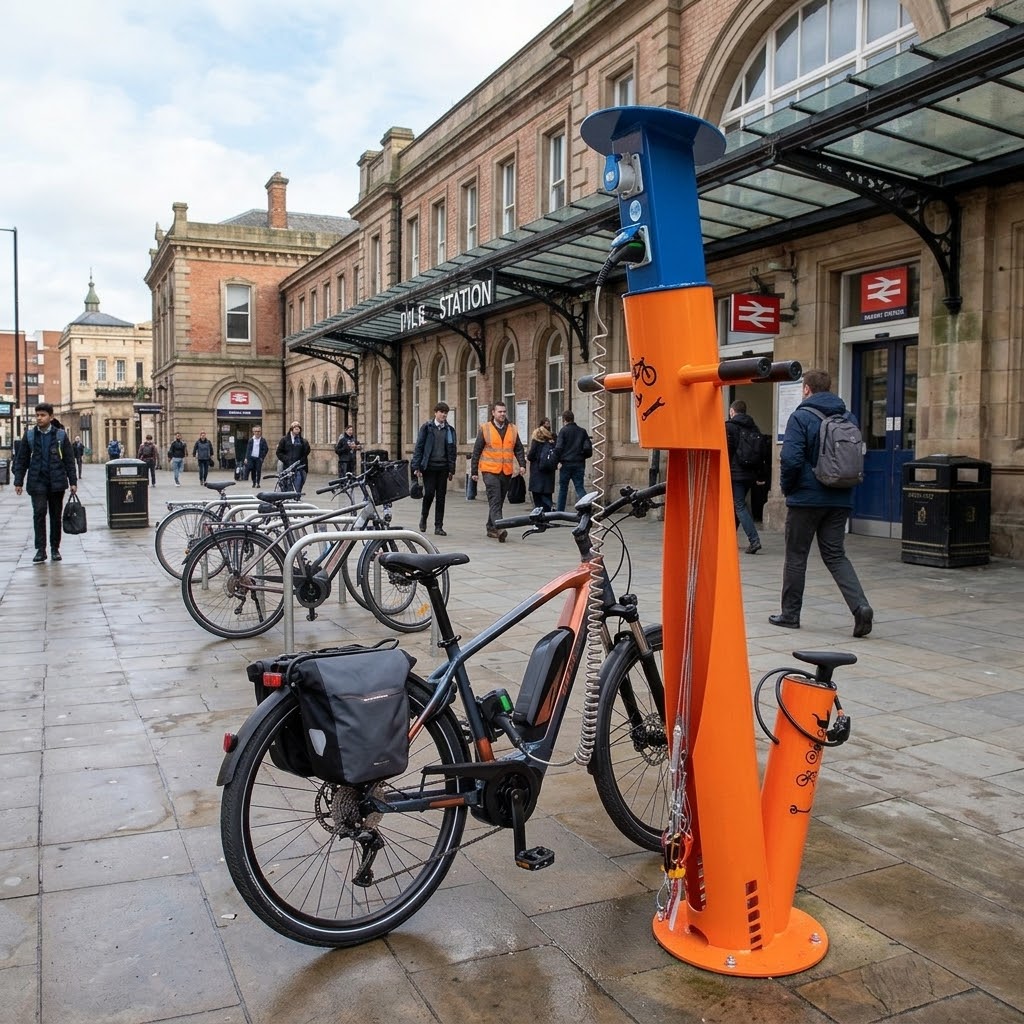
- CWIS3 & Active Travel England Schemes: Public-realm cycle hubs, railway station forecourts, and greenway trailheads frequently specify standalone public repair totems to encourage everyday cycling confidence.
2. Specifying Heavy-Duty Public Cycle Repair Stations
Outdoor repair stations in schools, retail parks, and public squares must withstand constant use, rain, and potential tampering:
| Specification Feature | UK Commercial & Public-Realm Standard |
| Structural Body & Finish | Heavy-gauge structural steel column fabricated under EN 1090-2, hot-dip galvanised to DIN EN ISO 1461, and powder coated in any architectural RAL colour |
| Integrated Bicycle Work Stand | Rubber-coated support arms positioned at ergonomic waist height to hold the frame or saddle safely without scratching paintwork |
| Tethered Stainless Steel Tools | Multi-size Allen keys, Torx drivers, open-ended spanners, tyre levers, and screwdrivers secured on heavy-duty braided stainless steel cables |
| All-Weather Manual Track Pump | High-pressure outdoor floor pump with universal Presta/Schrader valve head and pressure gauge—zero electrical supply required |
| Base Fixing | Thick flanged steel baseplate with tamper-resistant anchor bolts fixed into a concrete pad or paved sub-base |
3. Integrating E-Bike Charging into Covered Cycle Shelters
Where clients request e-bike charging inside enclosed cycle compounds or modular steel cycle shelters, early coordination between the shelter manufacturer and M&E contractor prevents costly site retrofits:
- Weatherproof Shelter Coverage: Charging points should always be housed beneath a weatherproof roof canopy—such as our ARB, PAM, Quantum, or Skyflat shelter systems—to shield sockets and battery chargers from driving rain.
- Dedicated Steel Cable Containment: Specify concealed or surface-mounted galvanised steel conduit routes along internal roof purlins and structural columns so M&E contractors can install IP66-rated RCD-protected 13A sockets cleanly without drilling structural posts on site.
- Ground-Level Bay Layout: E-bikes typically weigh 20–28 kg. Pair charging bays with ground-level Sheffield stands or multi-space toast racks (or lower-tier bays alongside gas-assisted two-tier racks) so riders never have to lift heavy frames overhead.
- Secure Access & Ventilation: For multi-residential and workplace hubs, housing e-bike charging inside a ventilated, access-controlled compound protects high-value bikes from theft while maintaining natural airflow.
4. Custom Branding, Wayfinding & Architectural Coordination
Because repair totems and cycle shelters often sit prominently near main building entrances or public footways, visual consistency matters:
- Matching RAL Colourways: Coordinate repair stations, shelter frames, and internal stands in matching RAL 7016 Anthracite Grey, RAL 9005 Jet Black, or corporate/campus brand colours.
- Custom Laser-Cut Signage & Graphics: Repair totems can incorporate vinyl wraps or laser-cut steel panels displaying council logos, university branding, QR maintenance guides, or local cycle route maps.